

Team Chat
Channels, direct messages and agents in Team Chat – how to coordinate with your team and bring the agent into conversations.
Open in ClapilotIn Team Chat, your team coordinates in channels and direct messages. The agent is part of it: mention it, and it answers questions using what it knows from your workspace or takes care of tasks for the team. Every new user is automatically in the #general channel.
Layout
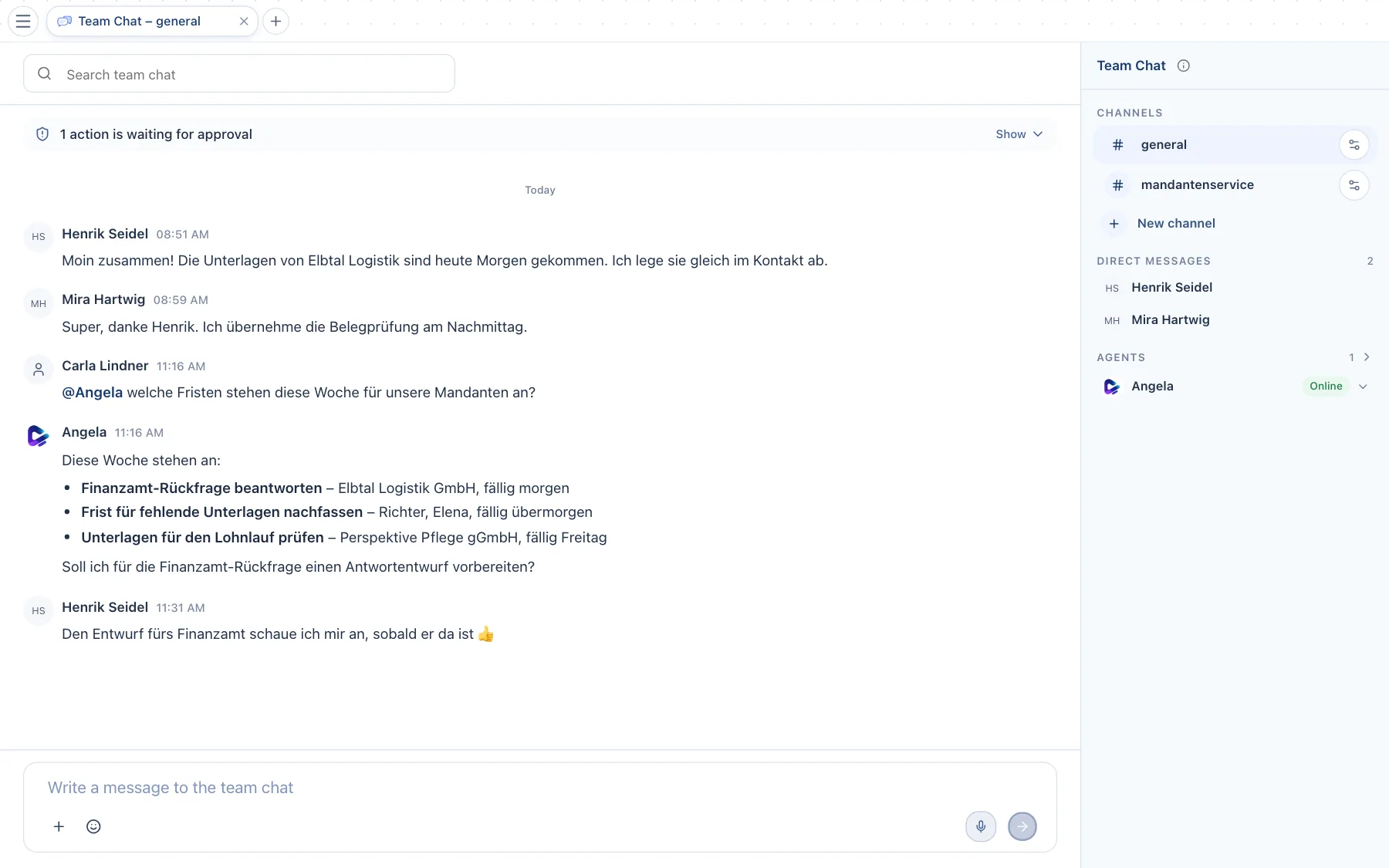
- Search – searches Team Chat.
- Mentioning the agent – with
@angelayou ask it a question or give it a job. - Agent's reply – appears directly in the channel and is visible to all members.
- Input field – Enter sends, Shift + Enter adds a new line. Use the plus button to attach files;
@,#and:work just like in the chat with the agent. - Channels – click one to switch channels.
- Channel settings – invite members and agents, set how the agent behaves, archive, restore or delete the channel, or leave the room.
- New channel – creates a channel: public for everyone or private for invited members.
- Direct Messages – private conversations with individual colleagues. Below them are the Agents you can message directly.
From a message's menu, you reply with a reference to that message or copy its text.
Threads
Choose Reply in thread from a message's menu to start a thread on that message. Replies collect in their own column on the right (a separate view on iPhone), so the channel stays easy to follow. Below the message, everyone sees how many replies there are, when the last one came in and who is taking part; a dot marks new replies in threads you are part of.
- Also send to #channel – shows your reply in the channel as well.
- Notifications – only the people who wrote in a thread are notified about new replies, not the whole channel.
- Agents in threads – mention the agent with
@and it answers in the thread, knowing the thread's history. Once an agent has answered in a thread, you can keep talking to it there without mentioning it again.
Reactions
React to a message with an emoji, like in Slack: from the message menu (👍 ❤️ 😂 🎉 👀 ✅ or More reactions…), from the icon next to Reply in thread when you hover over the message, or from the small plus button after existing reactions. Each emoji shows under the message with its count; your own reactions are highlighted. Clicking a reaction adds yours or removes it again, and hovering shows who reacted. Reactions also work in threads, direct messages and the iPhone and Mac apps. If you ask the agent to react to a message, it adds the reaction for you.
Using the agent in a channel
In the Channel settings, you decide for each channel how agents behave:
- Mention only – the agent only replies when you address it with
@. This is the quieter choice for busy channels. - All messages – the agent reads along and speaks up when it has something to contribute.
- More agents – invite specialized agents to a channel, for example a social media agent in the marketing channel.
- Agent-to-agent conversation – lets agents reply to each other in the channel. This is off by default.
Privacy: Everything in Team Chat is visible to all members of the channel. Personal topics are better discussed in your chat with the agent or in a direct message.
What you can ask the agent
- “@angela, briefly summarize the discussion in this channel.”
- “@angela, which deadlines are coming up for our clients this week?”
- “@angela, create a task for Henrik from this message.”
Voice rooms
Create a channel and choose Voice room. Join muted, enable your microphone to speak, and use the existing room chat alongside audio. Leaving or switching rooms stops audio. Video is planned for V2. The administrator must configure a voice server first.
Calls
In the browser and in the iPhone and Mac apps you can call colleagues directly: open the direct message and click or tap the phone icon at the top. On iPhone the call rings like a regular phone call, including on the lock screen and when Clapilot is closed; on Mac and in the browser it appears in the open app at the top right with Accept and Decline. During the call a small bar at the top of every page shows the duration, Mute and End call. If nobody answers, the person you called gets a missed-call notification.
In the iPhone and Mac apps you call an agent the same way: in a direct message with an agent, the phone icon starts a live conversation with that agent; in the chat it calls your main agent. The agent answers right away, replies by voice and handles tasks with its own permissions. During a call you can mute your microphone, switch to the speaker, interrupt the agent, or minimize the call and keep working. Calls require an administrator to set up the voice server.